Draft beer reference
Keg sizes & which kegerator fits them
There are five keg formats you will actually meet: the half barrel (15.5 gal, ~165 twelve-oz beers), the quarter barrel in slim and short shapes (7.75 gal, ~82 beers), the sixth barrel (5.16 gal, ~55 beers), and the 5-gal Cornelius homebrew keg (~53 beers). Fit comes down to diameter and height, not gallons: a half barrel needs a full-size cabinet, while sixth-barrel and corny kegs run in compact units. We track 336 real kegerators, 162 of which advertise two or more taps.
We may earn a commission when you buy through our links, at no extra cost to you. Learn more
Standard keg sizes at a glance
These are the published industry-standard specifications for each format — a reference, not a measurement of any particular keg (individual kegs vary slightly by maker). Beer counts are twelve-ounce pours.
| Keg | Gallons | 12-oz beers | Dimensions | Also known as |
|---|---|---|---|---|
| Half barrel | 15.5 | ~165 | 16.1″ dia × 23.3″ h | Full-size keg — the standard bar keg |
| Quarter barrel (slim) | 7.75 | ~82 | 11.1″ dia × 23.3″ h | Slim quarter / tall quarter |
| Quarter barrel (short) | 7.75 | ~82 | 16.1″ dia × 13.9″ h | Pony keg / stubby quarter |
| Sixth barrel | 5.16 | ~55 | 9.25″ dia × 23.3″ h | Sixtel — the craft-beer favorite |
| Cornelius | 5 | ~53 | 9″ dia × 23″ h | Corny keg — the homebrew standard |
Which kegerator fits which keg
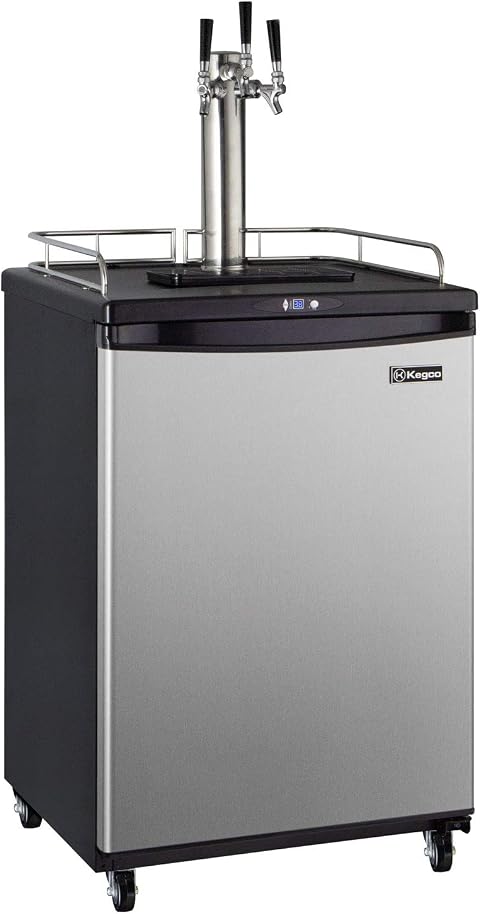
- Full-size kegerators take a half barrel — and therefore anything smaller. Many fit two sixth barrels or two corny kegs side by side, which is how dual-tap setups pour two different beers.
- Compact and undercounter kegerators are built around the 9–11″ diameter formats: sixth barrel, Cornelius, and the slim quarter in taller cabinets. The short quarter’s 16.1″ diameter is the sneaky one — it is as wide as a half barrel, so it does not fit where a slim quarter does.
- Mini kegerators (countertop) usually take only 5 L pressurized mini kegs — a different format from everything in the table above.
- The deciding specs are interior diameter and clearance height under the tower, not cubic feet — check the maker’s keg-compatibility list, and remember the CO2 tank either fits inside (costing keg space) or mounts on the back.
For the cabinet itself: among the 171 kegerators we track that publish full external dimensions, the median unit measures about 23.7″ wide × 34.1″ tall × 24.3″ deep — tower not included, so add tap-handle clearance before sliding one under a counter.
One tap or two?
A single tap pours one keg; a dual-tap tower pours two smaller kegs — usually two sixth barrels or corny kegs sharing the cabinet a half barrel would fill. That trade (variety versus volume per beer) is the real decision. Of the 336 kegerators we track, 162 advertise two or more taps — see the best dual-tap kegerators for current picks. New to draft beer at home entirely? Start with Kegerator 101 — the CO2, coupler, and foam fundamentals; this page is the keg-fit reference.
Frequently asked questions
How many beers are in a half barrel keg?
A half barrel (full-size) keg holds 15.5 gallons, which pours about 165 twelve-ounce beers or roughly 124 pints. A quarter barrel holds about 82 twelve-ounce beers, and a sixth barrel about 55. These are the standard published counts — real yield runs slightly lower once you account for foam and the last cloudy pour.
Will a full-size keg fit in a mini kegerator?
No. A half barrel is about 16.1 inches in diameter and 23.3 inches tall, and compact or countertop kegerators are built for smaller formats — typically a sixth barrel, Cornelius keg, or 5 L mini keg. Only full-size kegerator cabinets take a half barrel. Check the manufacturer’s keg-compatibility list, not just the cubic feet: interior steps, compressor humps, and the CO2 tank placement decide what actually fits.
How long does a keg last once tapped?
On a kegerator with CO2, a keg generally stays good for weeks to a few months — pasteurized beer at the long end, unpasteurized and hop-forward craft styles noticeably shorter as aroma fades. With a hand-pump party tap it is a different story: pumping pushes air (oxygen) into the keg, and the beer goes stale within about a day. Cold, constant CO2 pressure is what preserves it.
What is a corny keg?
A Cornelius ("corny") keg is a 5-gallon stainless keg originally built for soda syrup, now the homebrew standard. Instead of a bar-style coupler it uses two quick-disconnect posts (ball-lock or pin-lock) for gas in and beer out, and its large lid opens for filling and cleaning. At about 9 inches in diameter it fits most kegerators that take a sixth barrel — but it needs ball-lock fittings, not a D coupler.