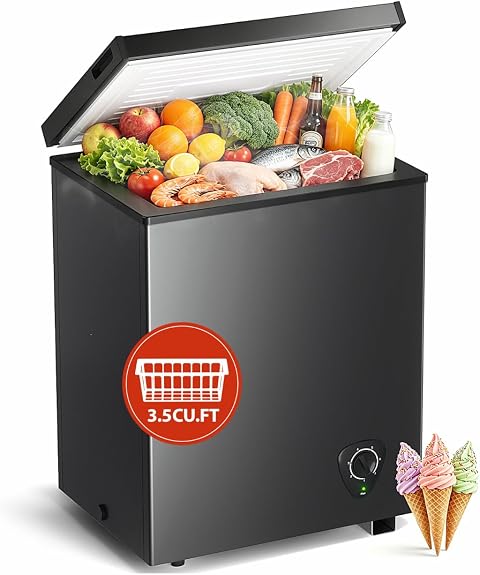
Buying decision
Chest Freezer vs. Upright Freezer: Which One Fits Your Space and Habits?
By MiniFridge.com · Independently researched · Published 07/16/2026
Choose a chest freezer when raw storage per dollar and per square foot wins: the open well swallows bulky and irregular items, holds cold better (the lid opens up, so dense cold air stays put), and usually costs less to buy and run. Choose an upright freezer when access wins: shelves and door bins keep everything visible and reachable, it stands in a fridge-sized footprint, and frost-free models spare you the defrost chore. We track 925 chest freezers (from $70) and 496 upright freezers (from $58) with live prices.
The one-question shortcut
Ask what failure would annoy you more a year from now. If it's “I ran out of room / spent too much,” get the chest — nothing matches its usable volume per dollar. If it's “I can never find anything and food dies at the bottom,” get the upright — shelves mean rotation, and rotation means less freezer-burned waste. Deep chest wells reward people who inventory what they freeze; uprights forgive people who don't.
Format vs. format, honestly
| What matters | Chest freezer | Upright freezer |
|---|---|---|
| Usable capacity | Nearly all of the rated cu ft — open well, no shelves | Less than rated — shelves/bins take room, but organize it |
| Fits odd shapes | Yes — turkeys, bulk cuts, boxes drop right in | Only if it clears the shelf spacing |
| Energy use | Typically lower — thicker insulation, lid-up design | Typically higher, especially frost-free models |
| Power-outage hold | Best case — ~48h full & unopened | ~24h typical, full & unopened |
| Defrosting | Usually manual — plan on the chore | Frost-free widely available |
| Finding food | Dig through layers; baskets help the top only | Everything visible at eye level |
| Floor plan | Wide footprint + lid clearance above | Fridge-sized footprint; door swing instead |
| Live price floor here | $70 (925 models) | $58 (496 models) |
Counts and price floors above come from our live catalog and update as models and prices move. Outage figures are the widely used planning rule for full, unopened units — your model's manual is the final word.
Where each one actually lives
Chest freezers end up in garages, basements, and utility rooms — places with floor space to spare, where bulk-buying households store a quarter of a cow, a hunting season, or a warehouse-club run. If yours is headed somewhere unconditioned, check the listing for a garage-ready rating rather than assuming the format handles it (our garage and outdoor guide covers why ambient temperature matters).
Upright freezers earn their keep in kitchens, pantries, and laundry rooms — anywhere the footprint must stay small and you open the door often. Weekly meal-preppers who need to see and rotate stock almost always live better with shelves. Compact uprights start around 1 cu ft, small enough for genuinely tight spaces (see our sizing guide for what cubic feet mean in practice).
Real models, both formats
Four honest reference points from the catalog — a compact and a family-sized unit in each format, every spec and price from the listing itself.
We may earn a commission when you buy through our links, at no extra cost to you. Learn more

chest-freezer · 2.7 cu ft
Compact, Deep Freezer Storage: 2.7 cu. ft. capacity holds a substantial 94.5 lbs. of frozen foods including cold meat, frozen dinners and ice cream. Keeps perishables frozen for your home or garage.

chest-freezer · 7 cu ft
5 Year Parts & Labour in Home Warranty: Industry leading warranty for peace of mind.

upright-freezer · 3 cu ft
[Large Capacity] With a capacity of 3.0 cubic feet, Midea WHS-109FW1 upright freezer provides ample space for all your frozen food storage, which can meet most of the needs. Product dimension 21.3"D x 19.7"W x 33.9"H
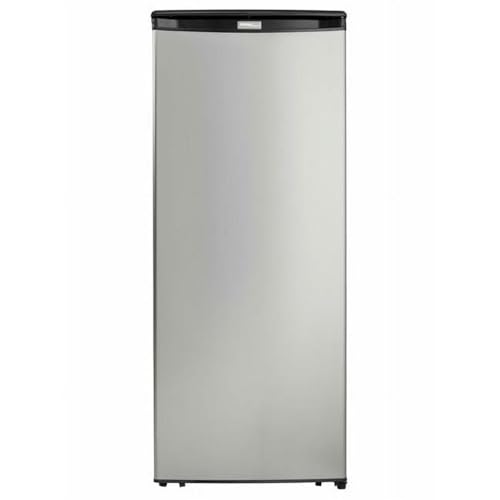
upright-freezer · 8.5 cu ft
This Danby Designer upright freezer is the perfect freezer for your home or cottage
The defrost question, since it decides more than people admit
Manual defrost means that once or twice a year (whenever frost passes about a quarter inch) you empty the freezer, let the ice melt into a drain pan or towels, and dry it out — an hour you must actually schedule. Frost-free models run periodic heating cycles so you never do that chore, at the cost of somewhat higher energy use and, some owners find, slightly more freezer burn on long-stored food because of the temperature swings. Bulk long-term storage favors manual; grab-often convenience favors frost-free. Our defrosting guide walks the manual process step by step.
Bottom line
Storage-per-dollar, energy thrift, and outage resilience: chest. Visibility, rotation, and a small footprint you open every day: upright. Browse every model with live prices — all 925 chest freezers and all 496 upright freezers, or put two side by side in the comparison tool.
Frequently asked questions
Which holds more food for the same footprint — a chest or an upright freezer?
A chest freezer. Its open well has no shelves, door bins, or fan housing eating into the cavity, so nearly all of the rated cubic feet is usable, and irregular items (a turkey, bulk cuts, pizza boxes) fit without fighting shelf spacing. An upright of the same rated capacity gives you less usable room but keeps every item visible and reachable on shelves.
Do chest freezers really use less electricity than uprights?
Generally yes, for two physical reasons: chest freezers are usually better insulated, and the lid opens upward — cold air is denser than warm air, so it stays in the well when you open it instead of spilling out of a vertical door. Many chest models are also manual-defrost, which avoids the energy cost of frost-free heating cycles. Check each model’s energy figure on its page rather than assuming.
Which keeps food frozen longer in a power outage?
A full chest freezer is the best case: the dense cold mass and lid-up design retain temperature longest — commonly around 48 hours when full and unopened, versus roughly 24 hours for a typical upright. Whatever you own, keep it full (even with water jugs) and keep the door shut during an outage.
Is a chest freezer or upright freezer better for a garage?
Either can work if the specific model is rated for the garage’s temperature range — look for a "garage ready" claim on the listing, which typically covers roughly 0–110°F ambient operation. Chest freezers are a popular garage choice because of the capacity per dollar, but verify the rating on the model, not the format.